
Why AI Can’t Replace Human Photo Restoration
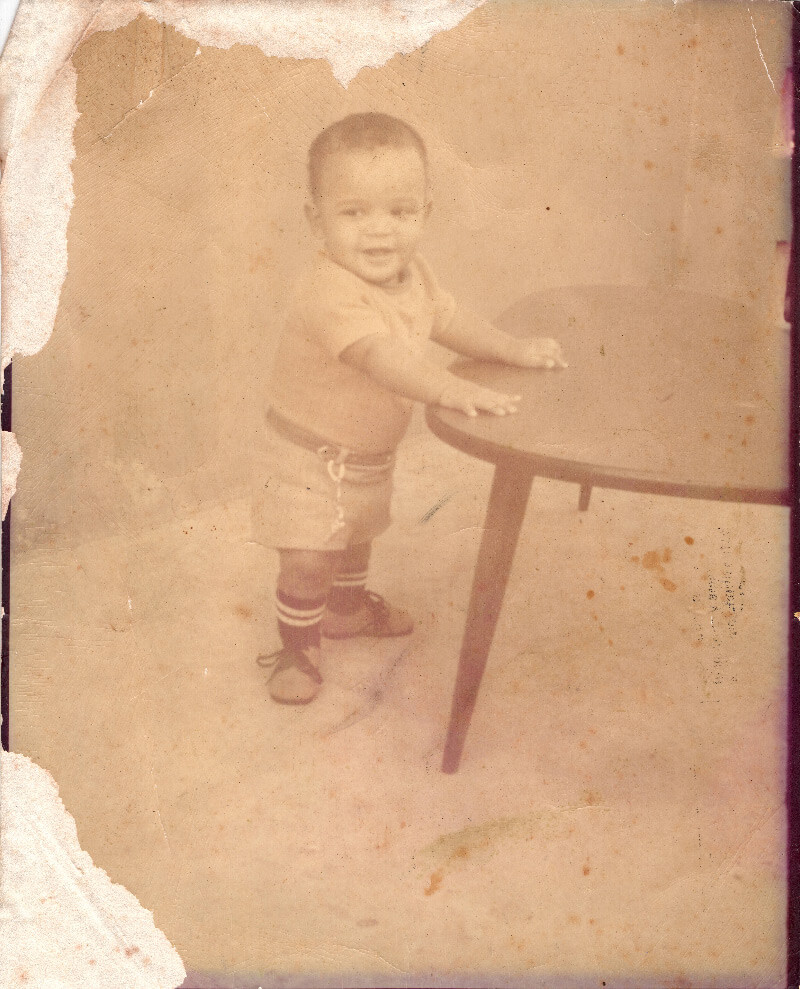
An example of a badly damaged photo
Artificial intelligence has made impressive strides in recent years. From automatic colour correction to object removal and face enhancement, AI-powered tools can now perform tasks that once required hours of manual work. For many everyday editing needs, these tools are undeniably useful.
However, when it comes to photo restoration, particularly of old, damaged, or historically significant photographs, AI reaches its limits very quickly. Despite rapid technological progress, human judgment, experience, and sensitivity remain irreplaceable.
Photo Restoration Is About Interpretation, Not Automation
At its core, professional photo restoration is not simply about fixing pixels. It’s about interpreting visual information that is incomplete, degraded, or ambiguous.
Old photographs often suffer from:
-
Physical damage such as tears, cracks, and missing sections
-
Severe fading or chemical degradation
-
Uneven exposure caused by age or original limitations
-
Facial details that are partially or completely lost
AI tools work by analysing patterns and predicting what might belong in missing areas based on data they’ve seen before. While this can be useful for generic imagery, restoration demands something more nuanced: understanding what should be there, not just what statistically could be there.
Human restorers rely on context, visual logic, and experience — skills that cannot be reduced to pattern prediction alone.

Historical Accuracy Requires Human Judgment
One of the most important aspects of photo restoration is accuracy. Restoring a family photograph, a portrait of an ancestor, or an archival image isn’t about making it look “modern” or artificially perfect. It’s about preserving the integrity of the original.
AI tools often:
-
Over-smooth faces
-
Invent details that never existed
-
Apply modern beauty standards to historical images
-
Guess incorrect textures, clothing, or facial features
A human restorer can recognise when something looks historically wrong or visually inconsistent. Decisions such as how much to repair, what to leave intact, and how far to enhance require judgment informed by both technical knowledge and cultural awareness.
Emotional Sensitivity Can’t Be Automated
Many restoration projects carry emotional weight. Clients often bring photographs that are deeply personal — images of relatives who are no longer alive, moments that exist nowhere else, or memories tied to family history.
Human professionals understand this emotional context. They know when subtlety matters more than perfection, and when restraint is more appropriate than dramatic enhancement.
AI systems, by contrast, have no understanding of emotional significance. They optimise for visual completion, not meaning.
This difference is critical. A restored photograph should feel respectful, authentic, and true to its origin — qualities that depend on human sensitivity.
Every Restoration Is Unique
Unlike modern digital photos, which often share similar lighting, resolution, and colour profiles, older images vary dramatically. The restoration approach for a faded black-and-white portrait from the 1920s is entirely different from that of a damaged colour print from the 1970s.
Human restorers adapt their process to each image, considering:
-
The era in which it was created
-
The photographic medium used
-
The level of damage
-
The client’s intentions
AI tools apply generalised solutions. They are excellent at speed and consistency, but restoration is neither of those things. It is a slow, careful, image-by-image process that rewards patience and attention to detail.
Understanding Image Intent Comes From Experience
One of the most overlooked aspects of restoration is image intent — understanding how the photograph was meant to look when it was first created.
Professionals with a background in photography bring an extra layer of insight. They understand lighting, composition, lens behaviour, and tonal balance. This allows them to restore images in a way that respects the original photographer’s intent.
AI does not understand intent. It does not know why a shadow exists, why a face is softly lit, or why certain areas were left dark. It sees data, not decisions.
AI as a Tool, Not a Replacement
None of this means AI has no place in photo restoration. On the contrary, when used responsibly, AI can assist with repetitive tasks, speed up initial clean-up, or help identify problem areas.
The key difference is who is in control.
When AI is used as a tool under human supervision, it can enhance efficiency without compromising quality. When AI is allowed to make final decisions, the result often lacks authenticity, accuracy, and character.
Professional restoration is not about doing the fastest edit possible — it’s about doing the right edit.
The Future of Photo Restoration Is Human-Led
As AI continues to evolve, it will undoubtedly become better at handling certain technical tasks. But the essence of photo restoration — interpretation, judgment, sensitivity, and respect for history — will remain human.
Clients who value their images understand this difference. They’re not looking for a generic automated fix; they’re looking for someone who understands the photograph as more than a file.
In a world increasingly driven by automation, human-led photo restoration stands apart precisely because it cannot be replicated by algorithms. It remains a craft rooted in experience, care, and an understanding that every image tells a story worth preserving.