
Why Photo Restoration Isn’t About Perfection
When people first enquire about restoring an old photograph, they often ask the same question:
“Can you make it look perfect?”
But professional restoration is not about perfection.
It’s about respect — for the image, for its history, and for the people connected to it.
Understanding the ethics of photo restoration means recognising that every mark, texture, and imperfection tells part of a story. The goal is not to rewrite that story, but to preserve it while carefully repairing damage caused by time.
Restoration Is Not Re-Creation
One of the biggest misconceptions about restoration is that it’s a form of reconstruction — that we are free to modernise, enhance, or “improve” an image.
In reality, ethical restoration follows a different principle:
Repair damage. Do not alter truth.
This is where photo restoration vs retouching differences become important.
-
Retouching enhances appearance.
-
Restoration preserves historical accuracy.
A restored photograph should still feel like it belongs to its original era — not like it was taken yesterday.
What Should Be Fixed in Photo Restoration?
A responsible workflow focuses on correcting deterioration, not altering character.
Typical restoration repairs include:
-
Tears, cracks, and physical damage
-
Dust, stains, and chemical degradation
-
Fading caused by age or poor storage
-
Colour shifts from material instability
These are problems introduced after the photograph was created — and therefore appropriate to correct.
Knowing what to fix in photo restoration requires distinguishing between damage and intention. See how this fits within a professional restoration workflow.
What Should Be Left Alone?
This is where ethical judgment matters most.
Not everything that looks imperfect is actually damage.
Examples of details often preserved:
-
Natural film grain
-
Period-specific tonal qualities
-
Soft focus from early lenses
-
Authentic shadows and exposure limitations
-
Signs of analogue printing processes
Removing these would erase the photograph’s identity.
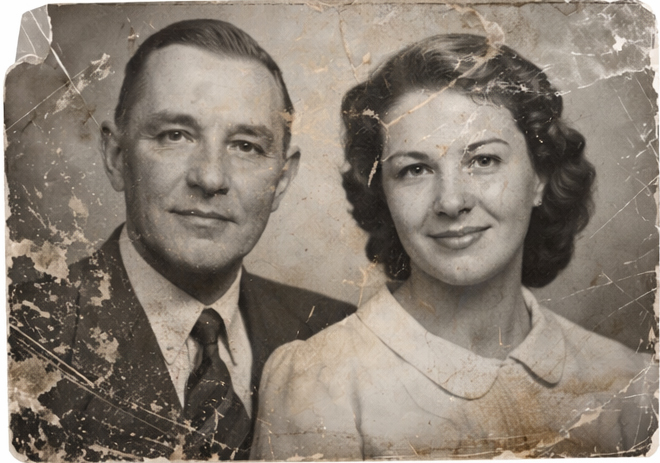
Title:
InformationBefore and after ethical photo restoration preserving original texture while repairing physical damage
Ethical restoration protects these characteristics because they are part of the image’s historical language.
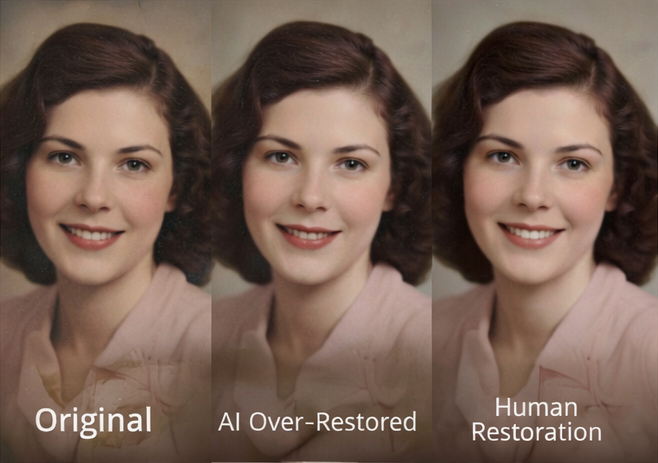
The Danger of Over-Restoration
Modern AI tools often aim for clarity, sharpness, and symmetry — applying contemporary visual standards to historical material.
The result?
Faces become overly smooth.
Textures disappear.
Lighting becomes unnatural.
The image loses its connection to time.
This is why preserving authenticity in photo restoration requires restraint as much as technical skill.
Just because something can be changed doesn’t mean it should be.
Restoration Is an Interpretive Responsibility
Every restoration decision asks:
-
Was this part of the original photograph?
-
Or is it damage introduced later?
-
Would correcting this honour the image — or rewrite it?
This interpretive process is what defines a professional photo restoration philosophy. It blends technical precision with historical sensitivity.
In many ways, restoration is closer to conservation than editing.
When Clients Ask for “Perfection”
Part of the ethical role of a restorer is education.
Clients often request:
-
Removing wrinkles from faces
-
Modernising tones
-
Increasing sharpness beyond what existed
-
Changing expressions or features
These requests move into retouching territory — not restoration.
A responsible workflow explains the difference and guides clients toward preserving the photograph rather than transforming it.
Why Imperfection Is Part of Authenticity
Old photographs carry physical presence. They reflect:
-
The materials available at the time
-
The limitations of the equipment
-
The human hand involved in printing and processing
If we remove every irregularity, we remove evidence of that process.
True restoration doesn’t chase flawlessness.
It protects memory.
Frequently Asked Questions
Is restoration supposed to make photos look new?
No. Restoration aims to stabilise and repair, not modernise. The photograph should remain faithful to its original period.
Can you remove anything a client asks?
Technically yes, but ethical restoration distinguishes between conservation and alteration.
Why keep grain or softness?
These are inherent to the original capture and materials — removing them erases authenticity.
Is restoration subjective?
It involves informed judgment, balancing technical repair with historical accuracy.