Title:
InformationIn this photo you can see the facial expressions have been altered by AI and the image has been cropped.
AI Photo Restoration vs Professional Workflow: A Real-World Test
AI photo restoration is becoming increasingly popular, promising fast results with minimal effort. But how does it really compare to a professional photo restoration workflow? As someone who restores damaged and historic photographs daily, I recently tested AI tools on real client images—and the results revealed some significant limitations.
While AI can be impressive at first glance, my experience showed that when it comes to accuracy, authenticity, and preserving important details, it still falls short of professional standards.
What Is AI Photo Restoration?
AI photo restoration uses machine learning algorithms to automatically enhance and repair old or damaged images. This typically includes:
-
Removing dust and scratches
-
Reducing grain and noise
-
Enhancing colour and contrast
-
Attempting to reconstruct missing details
These tools are designed for speed and convenience, often delivering results in seconds. However, that speed comes at a cost.
My Professional Photo Restoration Workflow
In contrast, a professional approach—like the one I outlined in my workflow article—focuses on precision and control at every stage:
Each image is treated individually, with careful attention to:
-
Preserving original detail
-
Maintaining accurate tones and textures
-
Avoiding unnecessary alterations
This level of control is essential when working with meaningful or irreplaceable photographs.
Testing AI on Real Client Images
To properly evaluate AI photo restoration, I tested it on genuine client images, including:
-
Faded vintage photographs
-
Grainy indoor portraits
-
Images with emotional and historical value
The goal was simple: enhance the image without changing the person, composition, or meaning.
Unfortunately, this is where the problems began.
The Cropping Problem in AI Photo Restoration
One of the most consistent issues I encountered was unintended cropping.
Even when explicitly instructed to keep the full image, the AI often:
-
Trimmed edges of the photo
-
Removed parts of hands or arms
-
Altered the original framing
This is a major problem in professional photo restoration. Every part of an image matters—whether it’s a hand resting on a shoulder or background details that add context.
Cropping, even slightly, can:
-
Change the composition
-
Remove meaningful elements
-
Alter the story behind the photograph
In a professional workflow, preserving the exact dimensions and framing is non-negotiable.
Why AI Changes Faces and Expressions
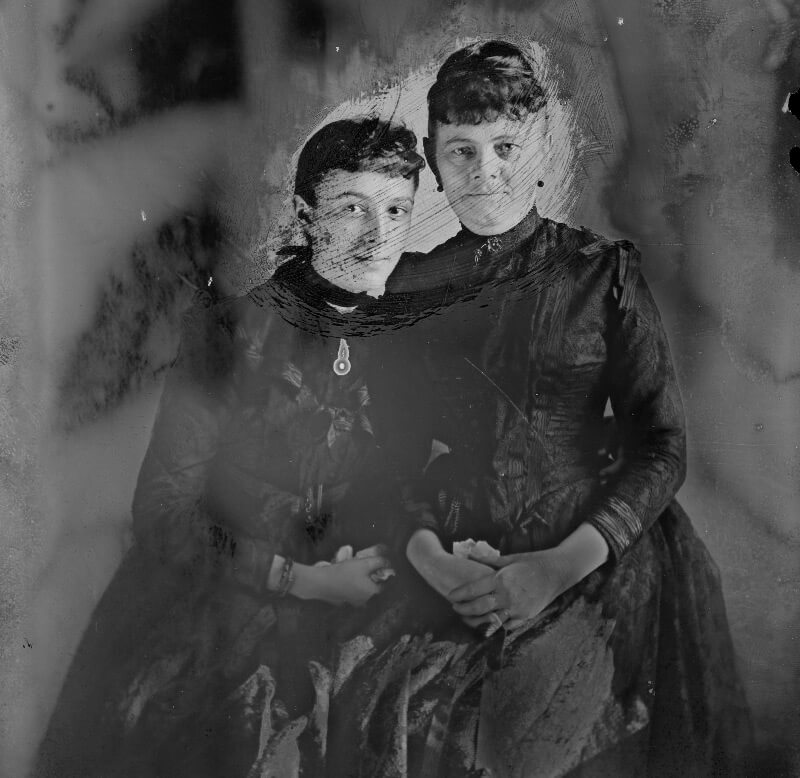
Another critical issue is how AI handles people.
Rather than simply enhancing the image, AI often attempts to “reconstruct” it. This can result in:
-
Subtle changes to facial features
-
Altered expressions
-
Slight shifts in likeness
While these changes might not be immediately obvious, they can significantly impact the authenticity of the image.
This happens because AI doesn’t truly understand the individual in the photograph. Instead, it relies on patterns learned from millions of other images, effectively “guessing” what should be there.
The result? A version of the person that looks plausible—but isn’t entirely accurate. There are many articles online that delve into the issue with AI and photo restoration.
Why Accuracy Matters in Photo Restoration
Photo restoration isn’t just about improving image quality—it’s about preserving memories.
Clients often bring photographs that are:
-
Deeply personal
-
Historically significant
-
Completely irreplaceable
Even small changes can have a big impact. A slightly altered expression or missing detail can mean the difference between a faithful restoration and something that feels wrong.
In professional restoration, the goal is simple:
Enhance the image without changing the person.
AI vs Professional Photo Restoration: Key Differences
| Feature | AI Photo Restoration | Professional Restoration |
|---|---|---|
| Speed | Very fast | Slower, manual process |
| Accuracy | Inconsistent | High precision |
| Facial Integrity | Can change features | Fully preserved |
| Cropping | Common issue | Fully controlled |
| Attention to Detail | Generalised | Image-specific |
When AI Photo Restoration Can Be Useful
To be fair, AI does have its place.
It can be useful for:
-
Quick previews
-
Basic colour correction
-
Light noise reduction
-
Initial clean-up before manual work
Used correctly, it can speed up parts of the workflow. However, it should not be relied on for final results—especially when accuracy is critical.
Final Thoughts: Can AI Replace Professional Photo Restoration?
Based on my experience, the answer is no—not yet.
AI photo restoration is a powerful tool, but it lacks the control, judgment, and restraint needed for high-quality, professional results. Issues like cropping, altered facial features, and loss of authenticity make it unsuitable for restoring important or sentimental images on its own.
The best results still come from combining technology with human expertise.
If you have a damaged or faded photograph that needs restoring, a professional approach ensures that every detail is preserved—without compromising the integrity of the original image.
Need Help Restoring Your Photos?
If you’re looking to restore old photos professionally, I offer a service focused on accuracy, care, and attention to detail—ensuring your images are enhanced without being altered.
Get in touch today to bring your photos back to life.