
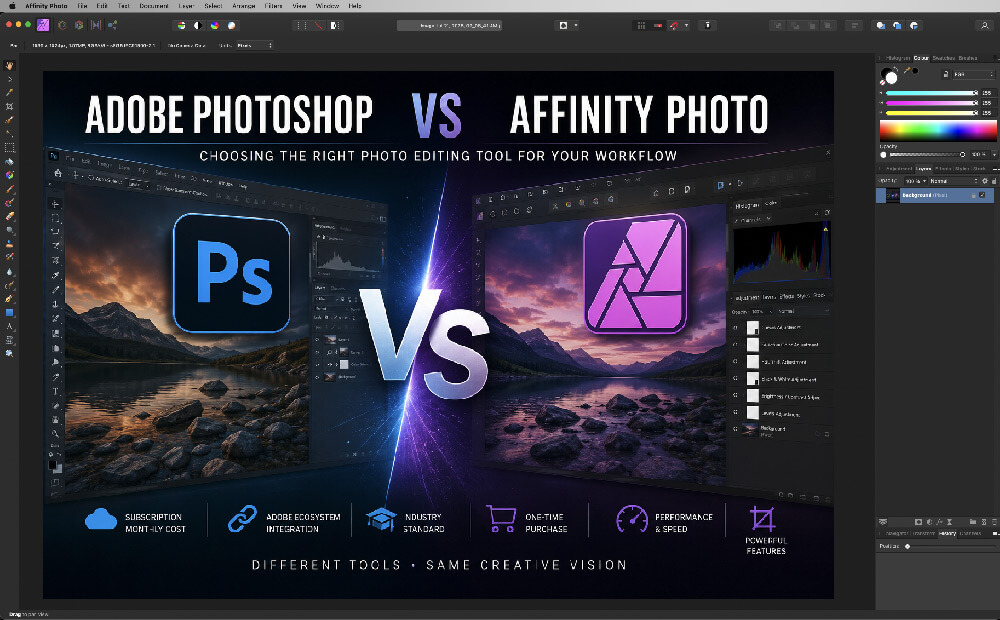
For more than three decades, Adobe Photoshop has been the undisputed king of photo editing. It transformed the photography industry, became the standard for professional retouching, and set the benchmark for image manipulation that every competitor tried to match.
As a professional photo retoucher, I’ve spent years working with Photoshop. It has helped me restore damaged family photographs, retouch commercial images, repair old memories, and produce high-quality work for clients around the world.
However, over the last few years I’ve noticed a significant shift.
More photographers, designers and professional retouchers are asking the same question:
Is Photoshop still the best choice?
For many users, the answer is becoming less straightforward. While Photoshop remains an incredibly powerful application, three major factors are changing the photo editing landscape: subscription pricing, rapid advances in AI editing, and the emergence of high-quality alternatives such as Affinity Photo.
1. The Subscription Model Is Driving Users Away
Perhaps the biggest criticism of Photoshop today has nothing to do with its editing capabilities.
It’s the subscription.
For many years photographers could purchase software outright and use it for as long as they wished. Today, Photoshop is primarily available through a monthly or annual subscription.
For professionals working every day, this cost may be justified.
For hobbyists, occasional users, retired photographers, or people who simply restore family photographs from time to time, it becomes much harder to justify an ongoing expense.
There is another concern many users mention.
If you stop paying your subscription, you lose access to Photoshop itself. Unlike the older perpetual licence model, the software is no longer available for editing once the subscription ends.
For some people this creates the feeling that they never truly own the software they’re investing in.
I’ve also spoken to photographers who found the cancellation process more complicated than they expected. While experiences vary, it has become a common discussion point in photography communities and one reason some users begin exploring alternative software.
2. AI Is Changing Photo Editing Faster Than Ever
The second reason Photoshop’s dominance is being challenged isn’t another editing program.
It’s Artificial Intelligence.
Only a few years ago, AI editing was viewed with scepticism.
Today it can perform tasks that once took experienced editors hours.
Examples include:
- Object removal
- Background replacement
- Subject masking
- Noise reduction
- Sky selection
- Automatic colour correction
- Image upscaling
As I’ve discussed in previous articles, AI is far from perfect.
It still struggles with complex restorations, historical accuracy, facial consistency and creative judgement.
However, there is no denying how quickly the technology is improving.
Many photographers now complete basic edits using AI-powered software before ever opening Photoshop.
This doesn’t mean Photoshop is obsolete.
It simply means photographers now have more options than ever before.
3. Affinity Photo Has Matured Into a Serious Professional Alternative
The third reason is perhaps the most interesting.
Affinity Photo has evolved into an incredibly capable professional editing application.
Several years ago it was viewed mainly as a lower-cost alternative.
Today, many professionals—including myself—use it for certain editing tasks because, in some areas, it simply performs better. It also has a very similar interface as Photoshop, with many of the same tools (clone stamp, marquee, eraser etc).
One example comes directly from my own workflow.
I regularly work with Insta360 panoramic photography.
Using an older version of Affinity Photo, I found that stitching and exporting Insta360 images was actually faster, more reliable and produced better results than the current version of Photoshop for the same workflow.
These interactive images were created using Affinity Photo, the stitching and colour correction is incredible, way better than anything Adobe Photoshop can currently produce.
That was a surprise.
When software costing a fraction of Photoshop performs better for a specific professional task, it’s difficult to ignore.
Affinity Photo also offers several other advantages:
- It is now owned by Canva and is free to download and use.
- Excellent RAW processing
- Fast performance
- Regular feature updates
- Familiar editing tools for Photoshop users
- Excellent support for high-resolution files
For many photographers, switching requires surprisingly little adjustment.
Does This Mean Photoshop Is No Longer the Best?
Not necessarily.
Photoshop still excels in many areas.
Its ecosystem, plugin support, advanced compositing tools and integration with other Adobe applications remain outstanding.
If your workflow depends heavily on Adobe Creative Cloud, Photoshop may still be the logical choice.
The important point is this:
There is finally genuine competition.
For years there simply wasn’t.
Today photographers can choose software based on their own needs rather than because one company dominates the market.
The Right Tool Depends on the Job
As a professional photo retoucher, my priority has never been software loyalty.
My priority is producing the best possible result for my clients.
Sometimes that means using Photoshop.
Sometimes it means using Affinity Photo.
Increasingly it also means using AI tools where they genuinely improve efficiency.
The software itself is only part of the process.
Experience, judgement and attention to detail still matter far more than the logo on the screen.
A skilled retoucher can create exceptional work using different applications because the knowledge behind the edits is transferable.
The Future of Photo Editing
The photo editing industry is changing faster than at any point in the last twenty years.
Artificial Intelligence is improving rapidly.
Alternative software continues to mature.
Competition is increasing.
Ultimately, that’s good news for photographers and retouchers because competition drives innovation.
Instead of asking which software is “best,” perhaps the better question is:
Which software allows you to produce the highest-quality work most efficiently?
For me, the answer is no longer as simple as saying “Photoshop.”
Today’s editing landscape offers more choice than ever before—and that’s something every photographer can benefit from.
Frequently Asked Questions
Is Photoshop still the industry standard?
Yes. Photoshop remains one of the most widely used professional photo editing applications, particularly in commercial photography, publishing and design.
Can Affinity Photo replace Photoshop?
For many photographers and retouchers, yes. Affinity Photo includes many professional editing tools and, depending on your workflow, may be a suitable alternative.
Is AI replacing professional photo editors?
No. AI is becoming an excellent productivity tool, but professional retouchers still provide creative judgement, complex repairs and high-quality finishing that AI cannot consistently replicate.
Should beginners start with Photoshop or Affinity Photo?
That depends on your goals and budget. Photoshop offers a mature ecosystem and extensive training resources, while Affinity Photo provides many professional features with a one-time purchase rather than an ongoing subscription.
Looking for Professional Photo Retouching?
Whether your images need advanced retouching, photo restoration, colour correction or complex repairs, professional experience still makes the biggest difference. The software is simply a tool—the quality of the final result depends on the person using it.
If you’d like to discuss a restoration or retouching project, I’d be happy to help.